A spaceship, a vessel, a portal
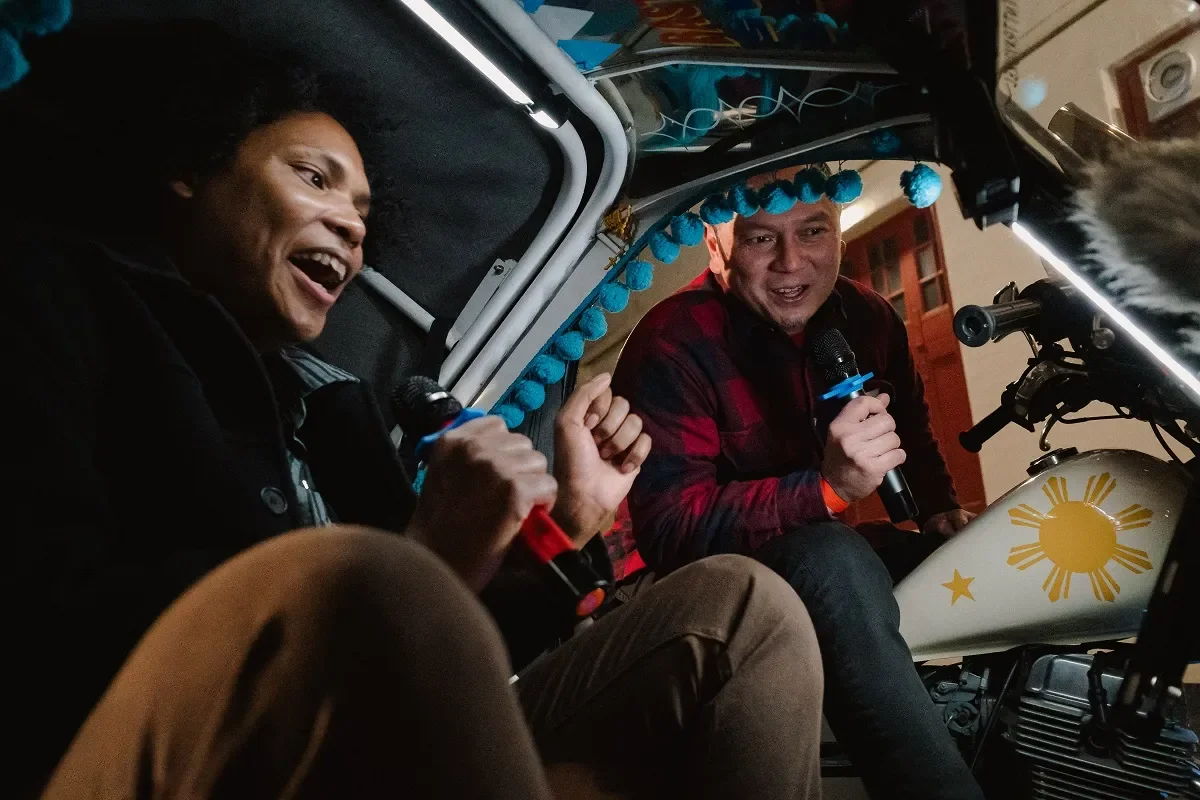
Julius Rea and TNT Traysiekl co-creator Michael Arcega sing karaoke together in the mobile art piece on Dec. 5, 2023 at Fort Mason. Photo Credit: Alejandro Ramos.
As part of the Substrate Arts Winter 2023 Pop-up held at Magic Theatre on December 5, Substrate Arts co-founder Julius Rea spoke onstage with the collaborative team behind TNT Traysikel: Michael Arcega, Paolo Asuncion & Rachel Lastimosa.
While TNT Traysikel has had many evolutions, the interactive art piece is a motorized vehicle and sidecar branded with Filipino cultural iconography. It also includes a karaoke machine for audience engagement. As the team has explored residencies, artistic partnerships and public activations, the team currently travels across San Francisco to capture stories around Filipino identity and migration.
Julius Rea: So, as I started this evening talking to H.P. Mendoza—who was one of the first people who inspired me as a Filipino artist—these three are really some of the people who are representing who I want to become in the future. So I really want to thank you so much.
And we’re going to try to keep this short so that we can all go outside and really experience this really revolutionary piece of art that I’m, once again, honored we can share.
So, I would love to turn back the clock a little bit and first understand what those initial ideas and what the initial concept and just what those initial discussions or texts or phone calls were about.
Originally constructing TNT Traysikel, I know that originally it was a brainchild between all of you, but also a discussion between Rachel focusing on the community engagement aspect of the creating SF SOMA district as a cultural heritage of the neighborhood for the Filipino community. And also Michael working with, I think it’s SF Arts Commission, initially to get funds to infuse live and really new and bold Filipino / Filipinx art. So I’d love to hear about what those initial discussions were like in those initial ideas.
Rachel Lastimosa: Okay, sure. I’m a former life in arts administration, I was arts and culture administrator with some of SOMA Pilipinas, the Filipino cultural heritage district in South of Market, and that was designated by the city of San Francisco in 2016 as an anti-gentrification measure—along with other districts such as like Bayview and Japantown.
In 2017, California Arts Council also recognized South of Market as a Filipino cultural district as an asset, you know, to the state of California. And this is really on the heels of over 125 years of history in the San Francisco Bay Area that a lot of folks don’t recognize of the Filipino community and the contributions that Filipinos have had in building this city.
You know, we are also settlers of this unceded Ramaytush Ohlone land, and we are part of this migration process but that is really connected to US policy and how mass migration still continues to this day. And so in a place that is so politically-charged as the South of Market where development is, I think about 60 to 70% of the city’s development happens in that neighborhood. You know, you see where the high rises go, you see where all the market rate condos are being built.
And the narrative is that it’s warehouses, its offices but there’s actually there’s families, there’s elders, there’s community organizations, you know. There’s like a long history of a richness of culture there in South of Market and so part of that designation is to really codify and use creative placemaking and people power to really stand the ground and to be able to continue to steward the neighborhood. And so part of the work that I was doing, as part of the cultural district, was to have community engagement around what would Filipinos and stakeholders and people who live in the South of Market [answer the questions:] How would they feel like they belonged in this neighborhood? What signifiers would make them connect to their identities?
So, we would have these design charrettes and these community town halls, where we’d have elders and youth and everyone in between, you know, drawing on poster boards, collaging, just talking about like, certain iconography like Carabao or Sampaguita. You know, animals and flowers and fruits and things that made them recognize like who they were and made them feel connected to home. And one of those things was the Jeepney.
There was this arts and culture committee that basically consisted of individual artists, community organizations. Legacy arts organizations like Bindlestiff Studio—shout out, yes. Individual artists like Mike and Paolo, Cool Arts, Kearny Street Workshop, Manilatown. I-Hotel. Those were organizations that were a part of this arts and culture committee, and so we presented the findings. of some of these design charrettes to this group and it led to this discussion of how can [Filipino artists and community members] have cultural markers like Japantown or like, you know, Chinatown if we can’t afford to own buildings in this district. And so you know, we thought about that Jeepney being like this movable icon that people could connect to, and maybe [Mike] should take away the rest of the story.
Michael Arcega: Yeah. So it was in that context the scene [was] set. And I was kind of thinking of how I could contribute to it, but also just thinking broadly, and to the credit of the San Francisco Arts Commission, they really reached out to the Filipino American community and were doing seminars to empower and kind of give opportunity to younger applicants. And I’m not a younger applicant, but I was like: Well, I I want to kind of come up with a project that is going to be rooted in Soma Filipinos, and is going to be a signal to the rest of the Bay Area, and hopefully beyond, that this community exists in this landscape.
I’ve done projects where I’ve created kind of Filipino-centered or Pacific-centered objects placed in land in the American landscape, and I was thinking that the traysikel could be something that can exist in San Francisco with the grant that San Francisco Arts Commission could fund. And, at that point, I knew that to create a traysikel was going to be too difficult [to construct] as an individual artist, and also, since this is like a [communal, site-specific] project and I’m taking data and information from the community. That’s when I reached out to Paolo as a builder and also an artist. I knew about the films that he was making on this Youtube series, and I reached out to see if you’d be interested in applying with me, and we applied for the grant and got it. And yeah, and then that’s how the project started.
Julius: Beautiful. And specifically, I’m now going to ask if we can have a clip of some of the history of TNT tricycle, play for us.
Paolo Asuncion: What most of that was was a residency that we had at St. Joseph’s Art Society. And the way that came about was Aimee [Le Duc], who was friends with Mike for [ten years] around the art community. St. Joseph’s was the biggest congregation of Filipino Americans in the States until the Loma Prieta earthquake closed the church down. And for years after that, it just kind of remained dormant and shuttered. And they were going to make it into a WeWork or kind of a co-working space at one point and those plans didn’t fall through until Ken Falk bought the place and made it kind of an events and art space.
And Aimee, to her credit, recognized that it was within the Filipino cultural heritage district. So she reached out to Mike because she had heard about the TNT project somehow… and I asked us if we wanted to do something like a project and do some kind of activation in the parking lot for one day. And we’re like: “It’s going to take more than just one day in a parking lot. This used to be a Filipino American church, and you’re gonna let us in just in the parking lot?”
Actually, we came up with a proposal—Mike came up with a proposal, and Amy generously and graciously campaigned for us and approved like a four-month residency at the church where we held this tip this thing called M.A.S.S, and it stands for More Awareness… something something…
[Everyone breaks out in laughter.]
Anyway, we held these panels every month. You saw there that we held a history panel talking about history in the Filipino Americans in Soma and in the States. We held a culinary arts panel, we held the visual arts panel and also a performing arts panel which was kind of the wrap up of the whole residency and that one was what’s called M.A.S.S. Maryosep. Anybody speak Tagalog? Anybody’s parents? Anybody hears their parents go: “Susmaryosep!”
Michael: Mario set, by the way is a collapse of Mary, Jesus, and Joseph. “Oh, susmaryosep!”
Paolo: And that whole thing you just saw was actually part of or a clip from a bigger project that we’re working on called Lost and Found: TNT in America, which is basically a documentary about the project. We’re still discussing the outcome—the final part, yeah.
Michael: That was we got a second grant from the Arts Commission to work on that short film. And that gave us a kind of context to put all of these things together. So those, like really like experimental panels, they weren’t like sit down conversations necessarily. They’re more like salons. And, like the food one, literally, they were cooking and preparing food, and then guests were able to come and eat—and all of it was free. All the programming that we can do, if possible, is free.
ulius: Well, speaking of abbreviations, I would love to hear more about specifically the title “TNT” and, you know, what is behind that specifically? I am afraid to say it in front of a bunch of Filipino folks who speak Tagalog because I am not very good at that even though I’m half Filipino, but can you please describe to me the origin of the name? And then also how that name really encapsulates what you’re trying to touch on and showcase?
Michael: “TNT” is, to many people, most non-Tagalog speakers will just think: “Oh, it’s dynamite! It’s dynamic, you know, explosive.” But for those that know, “TNT” is an acronym for “tago nang tago,” which loosely translates to “always hiding” or “hiding and hiding” and to many Filipinos is codeword for someone who’s undocumented. So, they might say like: “Oh, yeah, like we were TNT because we overstayed her visa, and then blah, blah, blah.” So, yeah, that’s where it stems from. And it’s a way to put it forward in the project that everyone’s welcome like, this is a boundary-less space.
Paolo: It’s kind of like an ironic name for the project since it’s “tago nang tago,” (always hiding) or “takot nang takot” (always afraid). You know, and then here it is. It’s like on the front end on the back of the [traysikel]. We’re announcing it, you know what I mean? And also we named the project personally, I think if I remember right, it was because it was right in the middle of the [Trump] administration that the project came about a lot of violence against Asian Americans. And it was time to just be like: “Fuck that. Let’s just be all out there and like here’s the name of it. There’s a lot of us here who are undocumented and deal with it, you know. Doesn’t make us better or worse than the rest of you know.”
Julius: Well, I think that that’s the really interesting thing about the piece like that. You say that it’s ironic that a piece about, in all honesty the the harm of migration and the harm of colonization, is that it’s built out of metal [and industrialized] parts. And also that it is physically and metaphorically hosting and holding stories joy… that breaks the whole reason that it exists. Like, it heals the harm that it was inspired from, in kind of this weird circular way for me.
So when you say that, it’s ironic that it’s like, it’s bold and it’s out, I think that that’s one of the beautiful things about, Rachel like you were saying especially in the video, being able to showcase our history, understand it to a certain extent. And, by extension, heal from it.
achel: Yeah, I mean, I think that visibility is honoring the experience. And so this sculpture is really honoring the place keeping of a community. And the fact that it’s mobile, means that it can bring that experience to Chinatown; it can bring it to Fort Mason. I mean, and there’s so much there’s so much history connected to the U.S. military in the Philippines. And just the fact that I mean, you could speak to this: it’s actually an American object.
Julius: Exactly.
Michael: Yeah, I was gonna say the other irony is that TNT is about an undocumented person or people, but the object itself is based on a kind of American history where this object is born out of American culture in the Philippines. It’s part of an expansionist, imperial, kind of global footprint. So this thing is very, very, very American. If not more American than then we see American. You know, like most people would ignore that the Philippines was an annexed place, you know. But [the traysikel] is so American. And so the irony of it being a foreign thing is really funny. Because it’s actually born out of the U.S.
Paolo: Military side cars in World War Two, NATO.
Julius: And I think that that’s what like kind of like leads me to my next question about what the discussions have been like with other communities or other ethnicities that have experienced, not this type of migration, but also other types of migration, other types of like imperialist harm, in all honesty. So I guess that that’s my next question is like, how have you seen it kind of mirror or how have you seen like the discussions with other groups that have not necessarily been Filipino, but have been moved or touched or kind of understand the migration aspects of this piece?
Rachel: There’s so many things about this project that have grown that I just had no idea. Like, it has a life of its own. But something that has really jumped out at me about it is like the notion of grief, and how that’s connected to longing and belonging. And I think it doesn’t matter if you’re Filipino. It doesn’t matter if you’re queer or if you’re a female or you know, what have you. Capitalism, imperialism feeds on othering.
And so, this object, this sculpture is almost like this vessel of holding. And I think that’s why we’re really leaning towards the Side Notes part of this project—being able to capture storytelling of like, you know, giving space for individuals to share their experience. Much like you’re doing Julius in your work, because it is this vessel that is meant to signal that you do belong… that you’re here in America, and so therefore you are American.
Julius: Interview over. That’s it.
[Laughter.]
ulius: I guess for like a final question to wrap us up so that you, our audience members who are here, can go outside and see and interact with the traysikel is that with the different variations and the different evolutions of it with Lost and Found, Sidecaroake, and then now, TNT Sidenotes, can you tell me what the experience is like finding new ways for TNT Tricycle to really bloom and create new experiences for audience members? And also, with that, what is next for TNT as a whole but also specifically for Sidenotes. I think that’s a two-part question.
Michael: Well, I think the first part in terms of the project’s blooming, I think it’s, it’s a really good synthesis of our three strengths. You know, in the different iterations, there’s usually somebody is, is leaning heavy or, you know, carrying a lot of weight pillows like filmmakers, that’s his wheelhouse, Rachel [does] everything. And I’ve been writing the grants.
So yeah, the other part is funding. It depends on funding too. So we have a couple of grants out, waiting to see and that will lead the direction of the project. If it’s funded, then maybe it’s a feature-length film. In the meantime, you know, maybe it’s a web series, I don’t know, but these activations are a kind of service too so you know. I feel like we’re, I don’t want to speak for everybody, but I’m gonna… I think we get a lot out of giving to the community and communities that we love. Like this project, we’re not getting rich off of this project. We’re wanting and loving to see people be able to have a cathartic experience through singing, through telling their stories, those stories that that are probably never heard, you know. I get a lot from that.
Paolo: Just to those stories were interviews, right. So, Rachel or I were asking questions. But even before that, and it was written in the original grant, Mike always knew that this was going to be kind of a collector of stories, but I don’t think we knew just how much of a catalyst for conversation it was going to be. The first time we brought the tricycle, the first time we got the tricycle out in its kind of bare metal form, we looked it over and then we’re like: “Let’s ride it to dinner. Right?”
So we drove it down the street to a Filipino restaurant. And as we were inside this crowd gathered around it, of course, right? So we walked out there to just answer any questions, right? And people would just offer up their stories to us. They would be like: “Is this yours?” And we’d be like, yes. Then, they would look at it and a switch would click and they’d be like, “No, I came here in 1979 and…” and they would just tell us their kind of origin stories. There’s something about the, the object or just like it’s kind of like a time machine or time and space machine, you
Michael: You know, so I mean, as the rarefied object that a lot of people haven’t seen in a long time, there was one woman when I was showing at the Asian Art Museum. She was like, she told me, she was like, “I was born in one.” And I was like, “What do you mean?”
She was like: “My mother gave birth to me inside a traysikel.” You know, it’s amazing.
Rachel: Yeah, I really think wanting to lean into it as a platform for voice. You know, the karaoke is one aspect of it. And it’s partly to counter that grief and that longing, and it’s that catharsis and that expression that happens in Filipino community. There is this like experience of like being like reserved, but once the earrings come off, it’s like: Oh, we’re dramatic! Or the earrings just get bigger!
Julius: I really like your earrings, Rachel.
Rachel: Thank you! So being able to really ground it in story, in storytelling and finding a way to capture these stories and really provide a space for these folks to own those stories. Because a lot of the times that we have these conversations, people are like: “I can’t believe I’m telling you this.” or like “I’ve never told anyone this before.” And so it’s a real honor to be included into that trust.
Paolo: “I’ve never been this loud before.”
Rachel: Yeah! “I really need to be at this volume and I’ve never had to be at this volume before.”
Michael: There is something about the interiority of the cab that is comforting and, kind of, it’s like a hug. And to folks who grew up in the Philippines, grew upriding traysikels—it’s like when you go away on a vacation and, two weeks in, you’re like “I really miss BLANK (hamburger, whatever).” And then when you finally get it, it’s like “Ohhhh.” It’s that space of fulfillment that happens and for those who have been away from the Philippines or maybe can’t go back for whatever reasons, they sit inside the traysikel cab and they’re transported and they’re suddenly feeling at home in belonging.
Paolo: [H.P. Mendoza] said it when he was in the cab: “I can’t believe I’m in one of these things in San Francisco.” Everybody says that. It’s surreal.
Michael: It’s one of five in North American, including Canada. So it’s a rare moment.
Rachel: It’s a portal.
Michael: Yeah.
Rachel: It’s that opportunity to remember.
Michael: I think there’s always something like that for folks in a diaspora. Unless you’re Native American, we’re all in some kind of part of a diaspora. And I think that space that is created from leaving another place or feeling a connection to another place, that gap, there is grief there. There is a longing, belonging like [Rachel said], and there is a poetic space that we hope to draw at and bring forward in the project.
Rachel: A liminal space. And that’s in the cab, it’s found in the cab.
Paolo: They’re so good…
[Laughter]
Michael: Like in the crowd of people singing karaoke, you saw it in the clip, I can’t even explain it. It’s inexplicable that feeling of joy that one gets. And I hope, one of these days, if you haven’t been to one, you can join us in that, tell your story and sing or cheer someone on.
Julius: I mean, I’m going to go to it…
As we close out, Rachel you said that it feels interesting to honor that grief and honor that experience and to be able to hold it. And I want to say that sentiment is the thing that makes this project and three of you inspire me to continue to hold space for others, so I want to say thank you so much—not just for coming tonight and being a part of this interview—but just thank you for your work. Because we’ve seen it and it will continue to open people up.
Note: All Substrate Arts articles collected through live interview transcript are edited for length and clarity.
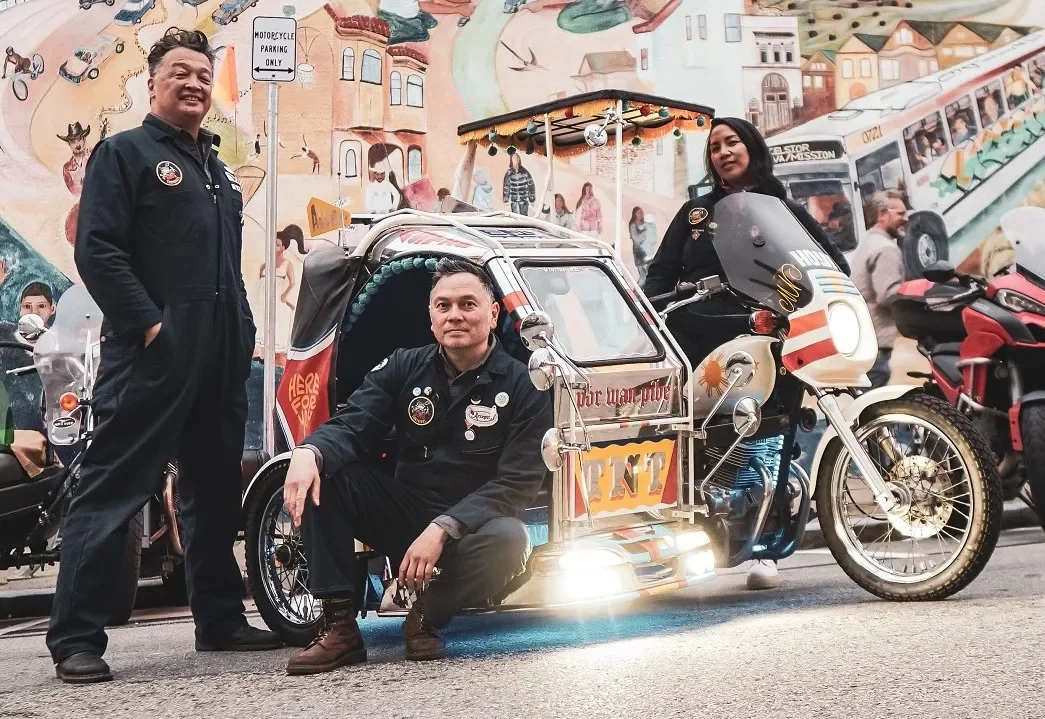
TNT Traysikel and co-creators Paolo Asuncion, Michael Arcega and Rachel Lastimosa. Photo Credit: Alvin Dizon.
In 2018 Michael Arcega, Paolo Asuncion and Rachel Lastimosa began working together in SOMA Pilipinas Cultural and Heritage District. Michael and Paolo started the TNT Traysikel project with support from the San Francisco Arts Commission (SFAC) grant. Rachel Lastimosa officially joined the team on their second SFAC grant to produce a short film called Lost and Found: TNT in America.
In 2016, SOMA Pilipinas- Cultural Heritage District became officially sanctioned by the county of San Francisco and the State of California. The community came together to express their needs for visual markers in the landscape. In response, TNT Traysikel was conceived. The roaming sculpture would signal the presence of the Fil Am community. The project began with a grant from SFAC for a sculpture that holds space in the streets of SF. Our efforts rapidly expanded to include three concurrent projects, 1) TNT SideCaraoke, karaoke activations of joyful sing-alongs and 2) Lost and Found: TNT in America, a short film that centers an immigrant object searching for a home in America 3) TNT SideNotes, listening sessions to give community members space to share their stories.
TNT Traysikel has been the anchor for many of our recent efforts. Our activities blur traditional practice and disciplines taking sculptural, spatial, relational, performative and cinematic form. For example, during a 4-month long Artist in Residence at Saint Joseph’s Arts Society (once home to the largest congregation of Fil Am Catholics in the US), we produced non-traditional “artist panels” called More Awareness Something Something (M.A.S.S.). We filmed over 60 experts on four Filipinx American topics- History, Visual Arts, Cuisine and Performing Arts. Every M.A.S.S. panel concluded with a TNT SideCaraoke sing-along.
In five years, we have co-produced over 2 dozen events involving hundreds of culture producers who intersects visual, culinary, literary, and performing arts, as well as motorcyclists. TNT Traysikel events occur in museums, galleries, plazas, parks and sidewalks. We never charge the public and welcome all.
Michael Arcega is an educator and visual artist working primarily in sculpture and installation. His research-based work is informed by History, geography, language and topics that deal with unbalanced power. Michael has degrees from the SFAI and Stanford University. His work has been exhibited nationally and internationally. He has received awards from Artadia, SFAC, Guggenheim Foundation among others. He lives and works in San Francisco as an Associate Professor of Art at SFSU.
Paolo Asuncion grew up in Manila. He is the son of an actor and was immersed in the film industry early on. He began in corporate films that led to independent documentaries. As a motorcyclist, His work uses the subculture as a springboard to explore subjects like religion, craft, family legacy, death and sex trafficking. His films have garnered awards nationally and internationally. He lives and works in the San Francisco bay area.
Rachel Lastimosa is an interdisciplinary artist, producer and performer, scoring for theater and film and has toured nationally and internationally. She has worked in the Bay Area as a community organizer, arts administrator and artist, supporting public art programming and performance. She founded AGASAN an expressive arts therapy program. Rachel’s focus on the intersection of arts, culture, equity and wellness continues to be the foundation for her creative pursuits and community service.