The Maestro
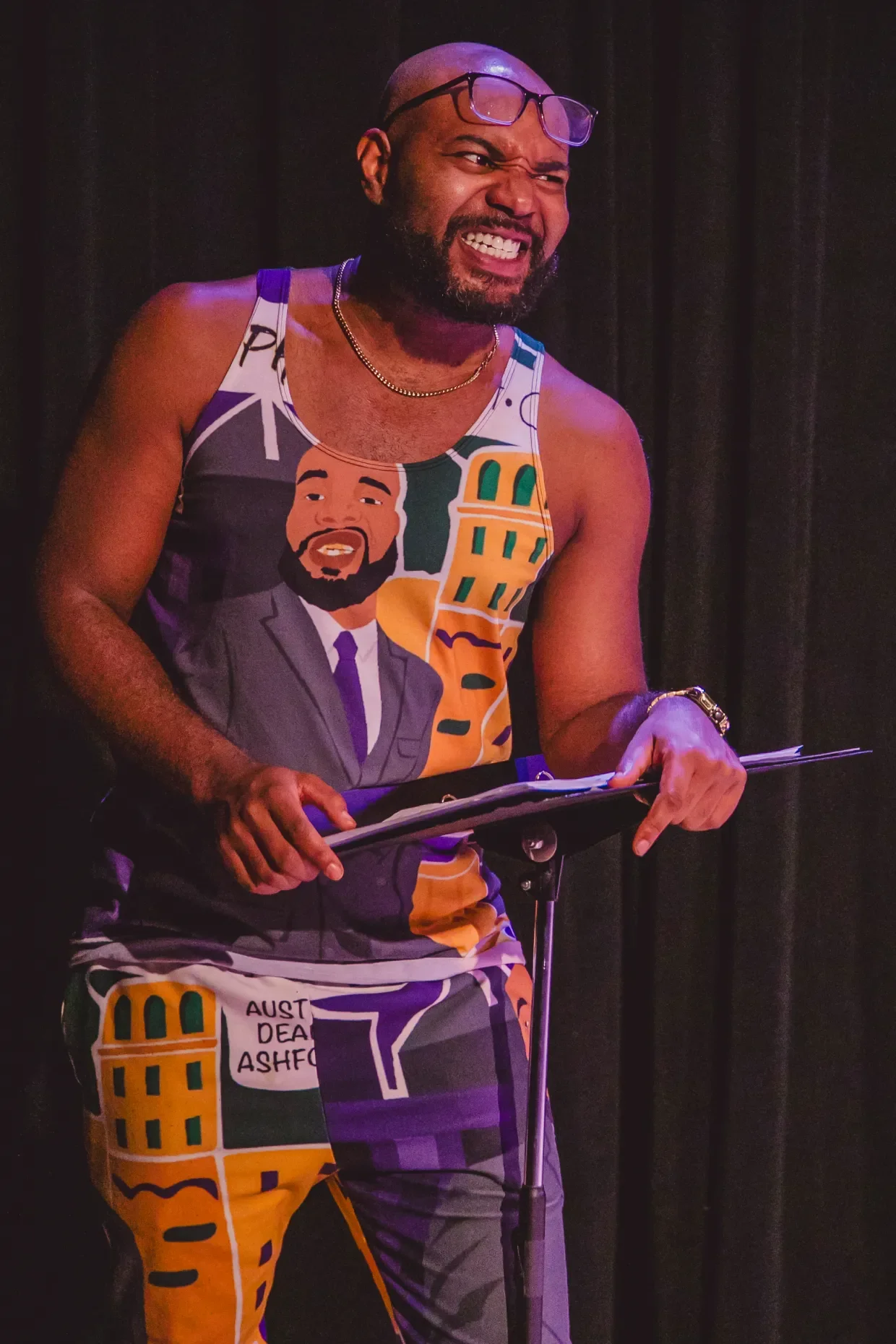
Austin Dean Ashford performs “Library Play” at the 2024 New Roots Theatre Festival. Photo Credit: Kayleigh McCollum
As the 2024 Artist-in-residence at Z Space in San Francisco, the writer-storyteller-performer-producer-griot shows off his unique style. Coming off a national tour, the critically-acclaimed Austin Dean Ashford shares his philosophy behind his art making. His latest piece, Library Play, shows a time-traveling Ashford on pursuit to save Black oral storytellers and libraries as we know it.
Julius Rea: All right. All right. So I know that as a writer and artist and performer, this question might be a little bit hard to pin down, but what was your first play or performance?
Austin Dean Ashford: Oh my gosh! Funny enough, I had never saw a play nor been in one until grad school. The first play I was in was LBJ “All the Way.” And then the very second play I think I was in was Lysistrata. And my third play was my one person show,
JR: What was the name of your first one person show?
ADA: (I)sland T(rap): The Epic Remixology of the Odyssey!
JR: I didn’t realize that that was your first one. I thought that you had been maybe testing it out a little bit before… But I remember seeing, I believe I saw that last year at Z Space, when you did it.
ADA: Yes, and thanks for coming.
JR: And, maybe it is Library Play, but what would you define as your most recent play or performance?
ADA: No, Library Play is the newest, latest thing that we did. But I did do Beauty and the Beat, like a month before it.
JR: So, how has your writing and creation process evolved or changed from (I)sland T(rap) to library play and Beauty and the Beat?
ADA: Oh my gosh! Actually (I)sland T(rap) was me learning a lot about foundational things with just hip-hop theater, solo theater, straight up playwriting. I think now that I’ve gotten to [Library Play], I’ve understood some of the rules to break them more freely than I think I was able to in (I)sland T(rap).
When I think about (I)sland T(rap), it’s very much still an adaptation. [With] Library Play, I’m not adapting any Eurocentric thing. It’s actually like, really rooted in Blackness—even though it’s a written language which is just a Eurocentric thing, which is a whole nother conversation.
JR: I mean, we can get into it!
ADA: (laughs)
I think that was the range. I think I still find myself, funny enough, in a conversation of oral storytelling versus written storytelling. So, I guess that thread kind of connects. And the idea of wanting to champion stories… I think the new thing now is,
I don’t think I really started that much of an afrofuturistic, monodrama writer, and I think now I’m more wearing it and championing it with pride. Instead of saying, “Oh, what are they doing with technology?” or “What does it feel like to go into the future?” — I think that’s kind of how the shift has started to happen.
JR: Just a clarifying question… obviously Afrofuturism is a specific type of art with a very specific idea around it. How do you define it inside of your work? Because I think that that’s kind of like a different thing than just saying: Black people with technology. Go.
ADA: Oh, make me be a champion of my PhD! Why don’t you?
The way that I use Afrofuturism is it helps me do an exploration of interdisciplinary art. I think I’m really grateful that I grew up in a multitude of different art forms. So I was doing music, doing spoken word, poetry, was doing dance, was doing speech and debate. I really like theater and film because they’re inherently interdisciplinary. So I need to work with a costume designer. I need to work with a director, a sound designer, a blocking person, a lighting person, and all of these things come together.
So I get to grab from Afrofuturistic artists in different disciplines, and let that inspire me in my holistic discipline, and I borrow from the Afrofuturistic framework. So a big thing in Afrofuturism or speculative fabulation or Black speculative narratives is the idea of Black identity and reclaiming Black identity. Another thing is world building, and building worlds where the character that you may have doesn’t typically already exist. So a lot of it is creating worlds where Black people or Black characters belong. And another [tenet] is re-imagining the past, present and future, and [that] kind of remixing, rearranging.
Well, I think those are the three strong traits I try to lean close to. And then if I have extra room, I’m like: “Alright, where does technology fit?”
I think the main thing actually I grabbed from Afrofuturism is probably something more broad, which is Black futurity and what does Blackness mean to be in the future. I think it’s an extremely radical act [for] people, who are often fighting against oppression, to say: not only are we going to exist from the past and current time [but] we’re going to have an existence tomorrow. I think that’s a really radical act to do, especially through art, which sparks the idea of people seeing things that don’t exist. So I think that’s kind of like the root that I like to grab from Afrofuturism.
JR: I’m happy that you talk about a holistic [and afrofuturistic] approach to Black identity, which I think is very, very present in your work.
[With] the national tour, you’ve been performing a lot of different places. [And even there’s a] difference between like Edinburgh to the Kennedy Center to Z Space. You know, I would love to hear how the experiences are with different audiences learning about these topics, and how does that play into this discussion of Afrofuturism, especially with holistic identity?
ADA: Oh my gosh, that was so good! I wish I got to have conversations with you frequently so my studies don’t seem so lonely.
JR: Okay, three or five years, and you’re like” “I might need to get another PhD!” Call ya boi.
ADA: No, not another one! Uh, different spaces… Okay, so I think a lot of it is just, um, if I’m being honest and truthful, I had a little jealousy and envy of nepotism art babies…
JR: (sarcastic) What do you mean?
ADA: Yeah, yeah, no, okay, let’s go!
There are people who are able to have so much opportunities and access to art because of who their parents are. Yes, I was jealous and envious! Because I was able to have access to sports, but I never had access to the arts and to learn about it. So I came so late, so by the time I found everything out, it was through a school educational format, and not even like a middle school or high school or college; [it was] graduate, so everybody’s already super advanced.
But the school circuit was able to let me do things like KCACTF (The Kennedy Center American College Theater Festival) which then led me to the Fringe circuit. So I had to learn how to go from the educational space to more so—not even like Off Broadway—it’s like no this thing called fringe, where experimental theater might be in a closet, it might be in the trunk of a car, might be in a basement.
[This medium] allowed me to have a lot of grit and imagination on what theater can be and also what solo performance can be. I think it was an uphill battle because I was so excited about solo performance, and I didn’t find out later that everybody thinks they suck. So, I was like: “Oh no, this is so rough!”
(laughs)
But that level of difficulty made me really fight hard to say: “Okay, I want to make sure I’m articulating a multitude of things.”
So then going from like education to Fringe to say: “Let’s just go to a regular festival.”
So now we are starting to go United Solo, off Broadway… and now we’re able to do regular festivals or regional theaters are starting to pick us up. When I was learning about the space or the exchange that I enjoy in developing and touring work is heavily on how, like Anna Deavere Smith, influenced me in Library Play. And this is the idea of, where does documentary style or Hip-hop theater fit in, where you’re developing something—much like in the New Roots Festival—I get to hear from the audience how they receive it, and let me go back and edit from the feedback.
Because sometimes I need to hear, “No, Black man. You did not articulate the Black woman character…” and somebody needs to g check you and let you know you’re being extremely patriarchal and misogynist, for example.
Thank you for being honest with me!
Because now I’m asking for an audience member to be really honest with me and saying: “I see where you’re going. This might help you get there.” So it’s almost learning from how stand up comics also learn when they’re touring [before] the big special, I borrow from them as a solo creator to say: “Okay, I’m gonna develop with this school, develop with this fringe. Eventually start doing the small, memorized version so I can get to bigger spaces.”
With the exchange with community and development and dramaturg and director and audience, how do I get this piece right? It helps me be able to have a piece that could go into multiple spaces, because I have different types of audience members react with the piece, and kind of helps me grow it and develop it to [understand]: Oh, this will do good in a fringe, an educational space, a professional theater, an equity theater, the school theater….
Like an [Historically black college and university] background, I still went to a PWI (Predominantly White Institution), so I have to know how to maneuver in both spaces, and that helps, but it also helps with the idea of age and generationalism. I like the kind of plays where grandma, grandbaby and whoever in the middle can kind of be in the same room, and everybody leaves with something, but it doesn’t have to be the same thing they all leave with.
JR: I think it’s really beautiful that there’s a cognizance with you that the play is a living document, and that it’s getting better and better and better every single time that it’s performed, and also when that there’s a connection with the audience.
And in all honesty, when asking that question, I knew that I was potentially creating a conversation where I was literally going to ask a black-and-white question. And it’s also kind of very afrofuturistic and holistic, that you presented a holistic futuristic answer to that. So that’s pretty funny.
ADA: Maybe I’m just preparing for my dissertation defense through you.
JR: Yeah, this is actually just prep. I’ve actually been sent by them.
ADA: (laughs)
Okay, no, so sorry, Dr. Carney and Dr. Smith. I’m doing the best I can right!
JR: I have a question about when you are sharing it with other people, was there a time where you shared a work in development… where somebody said something that was like, “Whoa, you do not get it…”
And then in the inverse, have you experienced a time where it was so picture perfect… where the audience really does get almost 100% of what you’re trying to create?
ADA: Oh my gosh, yes. So it’s a play that I’m working on now. It’s probably one of the plays I’m working for next year. It was my MFA graduate thesis, because I had to do a thesis for acting or writing. It was my third solo show called BLacKting, and I did it at a predominantly white institution.
And I noticed that it was so much Black honesty, white people just had a difficult time with me being that Black in a white space. And I never dealt with that.
Honestly, when I first came on the scene with the (I)sland T(rap), I’m adapting a white [story]; I’m turning into, like snakes and trees. So it’s very palatable Blackness, right? Then I get to BLACK BOOK, but I’m doing speech and debates. I’m doing a Eurocentric activity, with the sprinkle of Blackness in there, but it’s a comfortability there. But BLacKting was the first time I said: “Yo, whiteness! With the way you view me and stereotype me and place me in this craft, this is how I feel about it, here’s some of the ugly parts about it that I learned from the institution.”
I thought it was a problem with me, and so one of my playwrighting professors was like: “Imma be honest with you. This is one of the best things that you wrote, but it does make somebody who’s not ready to confront some of the things you’re talking about very uncomfortable. Because they say the way you started off was ‘very comfortable Black man’ and now we’ve just all found out that you’re not that comfortable.”
(laughs)
But I’m glad I had that experience, because it let me know, okay, this piece isn’t necessarily wrong, but [how do I] really understand the approach? So I can still say probably those dynamic things I want to say, but how can I say it to where you don’t have such a visceral reaction to where you don’t want to receive the message?
And then there’s moments like Beauty and the Beat and Library Play, where I think it’s kind of a crazy, difficult task, and then when it just works. And ‘The Beat’ was tough because it was really my play with the idea of Paul C. Taylor’s Black is Beautiful, and the idea of ocularcentrism and “beauty is in the eye of the beholder.” But what does that mean for blackness when there’s colorism and patriarchy?
So I took the original Beauty and the Beast, and I said “Instead of a father -aughter relationship, making a mother-son relationship, and let Belle and the beast (or beat) be one person and some like Doctor-Jekyll-Mister-Hyde-Frankenstein-thing.
I don’t think a lot of people get to hear someone who looks like me question beauty, and what does that mean? And what did it mean to my mother, who is a symbol of beauty to me.
So how was she affected? Which affects the way that I look at things. So I didn’t know how that was going to work, but the first time it came out and hit!
And Library Play, I was also struggling too, because libraries mean so much to me. But when actual librarians came and people who told me they just remember their relationship with the library, they’re like: “No, this is it’s on the right path. We’ve been waiting for you.”
Sometimes you have, like, a difficult ask, and you don’t know how it’s gonna land. You don’t know until the audience’s reaction whether you’re right on the money or you have to re approach this in another way.
JR: I see you walking a tightrope, and also very quickly mastering the tightrope, without necessarily realizing that you’ve been walking on the tightrope or realizing how far, and it’s very interesting hearing like all of the aspects of your mind (or maybe not all of it) and hearing how all of the dots you are naturally connecting with your work, and how that process brings up more dots. So it’s really, it’s really fascinating to hear that answer from you.
ADA: Thank you.
JR: And speaking of a segue, one thing that I’ve brought up with people when I’ve talked about you or your work—that’s very literally you—is your merchandise.
ADA: (laughs)
JR: Very, very chic.
Nikki Menez is one person who has described you as a one-man producing machine, and I guess that there is a question of, what is the process for you when you have to turn off producer and become playwright, or turn off playwright and become performer, or turn off performer and become producer. Or what is that like to have them all be intertwined all at the same time?
ADA: Oh, you’re asking a good question. Oh, my gosh, you’re getting into my fifth chapter evaluations of the future of modern drama.
JR: I TOLD you that they sent me from the university!
ADA: (laughs)
So that was the tough thing when I tried my dissertation, is I thought I was being so cool as interdisciplinary writer and also the performer and actor… and the real thing through that process, you recognize, if you don’t know how to produce, it’s almost all a waste.
…The reasons why I even started doing solos, personally, was I didn’t get into one of the best, biggest grad schools. You know, I got a letter of recommendation from Denzel Washington, so I’m thinking, I’m going to Juilliard, Yale, NYU. And it was no, no and no.
So I didn’t have the chance to get, like, the straight agent right out of school. So if I want to do this thing, how can I actually do it and make it somewhat of a profession? Luckily, I was a party promoter in undergrad, so I learned how to promote and do marketing of live events through parties and being a rapper. And when I went to the theater space, it’s like, “Oh, this is still live events!”
I was learning the art, learning how to write, learning how to act…. Going through school competitions and festivals, if you want to produce, even if you’re doing a fringe, [you have to ask] what’s your fire looking like? What is the costume looking like? What is the preview? What is the trailer? What is the clip? What is the pitch? What is the synopsis?
Someone’s in front of you for 30 seconds. You have to sell the show. You got tickets. What do you say? And how do you do it, and how do you get better at it?
I think I started doing a lot better as a producer when I said: “All right, start renting out theater venues.” [When BAM House] was still The Flight Deck, it was a four-hour minimum. I’ll rent it out for five hours. From that five hours, I could do two hour-long performances. There’s 100 seats. I could sell at 200 shows. And I’m selling merch in the lobby, you know. Parents running ushers, auntie running.. and that facet let me also recognize that this thing can move when you know the other side of producing.
I saw so many of my Black writer friends or Black actor friends who don’t get to work because they’re waiting on somebody to give them a call. And I was like, I cannot wait on somebody to give me a call to do my thing.
So you have to do it in a closet or a garage or a festival. Learn how to do it on that scale. And hearing about people like David E Talbert and Tyler Perry…. It’s very, very helpful to know people out here at churches, community centers and libraries still doing their thing, even though it’s not on the Broadway route.
Now the level I’m at is then when I’m first starting to write a piece, I’m automatically thinking about production and merchandising from the jump.
Honestly, that’s what lets me know if I want to continue to pursue a piece of saying: “Can I see this actually being produced and actually being done? If I was to do it, how would I do it? What’s the attraction?”
Because one of the tough things that people don’t like to talk about theater or in arts administration is it’s tough selling tickets and seats, especially post-COVID and houses don’t look the way that they used to look.
JR: (scoffs)
ADA: (laughs)
We really got to get creative out here if you want to stand out, especially me. So what I’m trying to produce, it’s not like I have a cast of 20 people. No, I have to literally go through an entire list of people I’ve never met. That’s why we do a lot of school visits, a lot of newspapers, a lot of just to put that extra touch and flare. But those small touch points, they add up after a while, and I’m starting to learn if somebody likes your work, they might like the next thing you do and the next thing you. So, after a while, producing, it’s difficult but in the long run, it’s helpful to be able to have those email blasts for people who want your work to continue going on strong.
JR: I guess that the thing that was really interesting about Library Play was the discussion of the griot, the discussion of libraries, the discussion of storytellers as historians. Can you tell me a moment where that really clicked for you through academic, personal or artistic spaces?
ADA: Um, I think I was being groomed as a gradual griot myself. In high school as a speech and debate nerd, I went to James Logan High School. My teacher (Tommie Lindsey) was a MacArthur Genius Award winner who won an Oprah’s Angel award, and was the first black Valedictorian University of San Francisco; he installed in me that speech and debate is cool, and learning to advocate for Blackness and the equity of life and value of life for Black bodies is important.
And [I’m learning that while] I’m doing spoken word poetry, while I’m doing music. So then and I do that while I get to college and I’m at Wiley College being a great debater. [Knowing] that advocacy of these stories and these people and their real life experiences matter—and arguing that through performance—I’ve always just felt like I’d be more interested in than the other route I could have went for for a law.
Now, granted, can I understand a good argument and can I tell someone some of the best of them? Yes, But I noticed that doesn’t actually generate change in the way that a story is more palatable for somebody to be open to the idea of change. I found that someone is more likely to be open to a concept that’s not their own, and go against cognitive dissonance when they relate in a character to a story… rather than somebody arguing at them or what they’re going through. You have just a better chance or entry point, I have found.
And that also allows me to kind of advocate for Black oral storytelling, which has lasted for a long time. But through COVID and the digital era, we’re really losing it in spaces. So a part of me wants to just advocate for us knowing our truth, because things are being so heavily curated for people that a lot of people don’t know what the root is and we’re trusting the sources that are giving us stuff—I think a little too much without any question.
But I’ve always wanted to create pieces that can do multiple things in one sitting, which is why I like the interdisciplinary approach. Because yes, I want to slide you some academia in a craftful way; yes, I do want you to get some rap, some music, some dance; I want you to learn something about Blackness. I even let people who aren’t Black in on a Black discussion. Not so you can judge us, but just so you can have some context on what we’re struggling with in a way that I don’t think a lot of people who aren’t part of the Black experience would even hear…
But, you know, people are people, but I think the fact that it’s happening when people are thinking about having the conversations is good enough for advancement, and what I could do probably in an hour’s time span. I can only do so much… but you did enough to where they’re like, “I gotta come back and get that part, because I only got this, this and this.” I think that’s what I’m starting to feel like I’m doing my ancestry proud, my family proud, my culture proud, in picking this very specific like Afrofuturism, monodrama form.
JR:Once again it what you’re saying, like, rings true, back to everything else that you’ve talked about through your pieces. The holistic nature of Afrofuturism is mirrored by the holistic nature of your producing style, and it’s also mirrored by the holistic nature of the content of what you’re actually producing.
It’s beautiful to see that everything seems to be connected in your artmaking metaphysically to physically to content to intent. And it’s interesting to also hear you articulate that.
This interview was edited for length, grammar, and clarity.